
Japanese Lourdes Under the Mountain’s Shield: The Extraordinary Story of the Nagasaki Monastery
There are places in Japan that completely defy common expectations. Instead of high-speed trains, neon signs, and crowded intersections, you find quiet, green hillsides where history intersects with events that are hard to explain by the laws of physics alone.
Most visitors to Nagasaki head straight to the Peace Park, the epicenter of the 1945 atomic explosion. Far fewer make their way to the city’s outskirts, onto the slopes of Mount Hikosan. Yet it is here that one of the most compelling pieces of modern history resides.
The Defiance of a Polish Franciscan
When Father Maximilian Kolbe stepped off the ship in Nagasaki in May 1930, few believed he would succeed. He had little money and knew no Japanese. Yet within a month, he was publishing a local edition of his magazine, Knight of the Immaculate. To expand his printing operation, he needed a permanent base.
His choice of land raised eyebrows among locals and fellow missionaries alike. From a construction standpoint, the site seemed like a mistake: situated on a steep hillside facing away from the city center, lacking proper roads, and directly exposed to fierce ocean typhoons.
Kolbe remained firm. The monastery, named Mugenzai no Sono (Garden of the Immaculate), was built precisely on that difficult, wind-swept slope.
A Natural Shield
On the morning of August 9, 1945, an atomic bomb exploded over the Urakami Valley, four kilometers away. The blast flattened the surrounding area, destroying the historic Christian district and its monumental cathedral, claiming tens of thousands of lives.
At Kolbe’s monastery, the impact blew out windowpanes and dislodged a few roof tiles. The structures themselves remained intact.
The terrain had served as a physical shield. The mass of Mount Hikosan absorbed and deflected the immense shockwave, sending it over the buildings. What had been criticized as a poor choice of location ended up saving the lives of the friars inside.
History Kept Intact
Today, an atmosphere of simple order prevails on the slopes of Hikosan, far removed from commercial tourism.
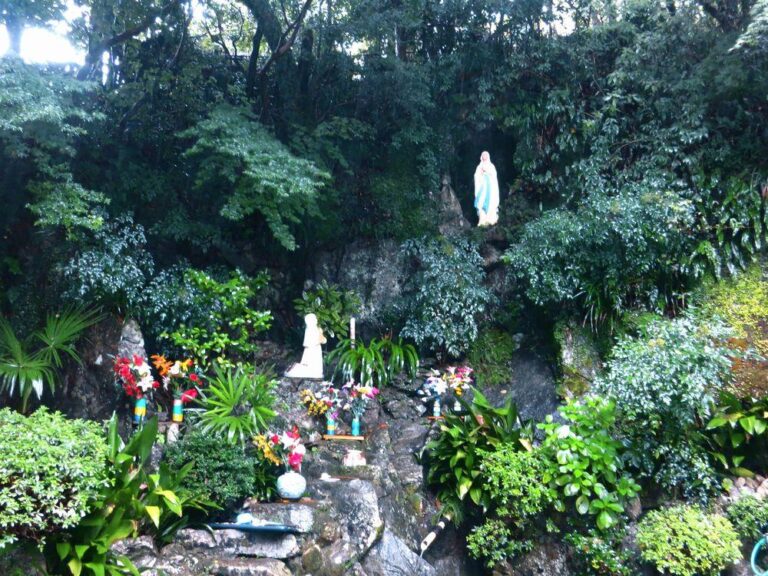
Inside the wooden building, Father Kolbe’s room has been preserved just as it was—simple furniture, early printing equipment brought from Europe, and original publications set in Japanese type. It feels less like a staged museum and more like a functional workshop paused in time. Nearby, surrounded by dense greenery, stands the stone Grotto of Lourdes—the same structure that survived the 1945 blast.
A Site Defined by Facts
For travelers exploring Japan’s history, Mugenzai no Sono offers a unique perspective. It avoids theatrical sentimentality, relying instead on documented facts and quiet reflection. It remains one of the most remarkable, off-the-beaten-path stops in Nagasaki.