
My Extraordinary Christmas in Rome
Lately, I’ve been thinking about what my ideal Christmas would look like. Maybe something like the Christmas Witka Wilka once had, when, just before Christmas Eve dinner, he came across a boy collecting bottles from the trash who didn’t even know what Christmas Eve was. He tells the story on the Służąc życiu channel.
And today I realized that I once had an extraordinary Christmas of my own.
I think it was October when Dorota said to me:
— “Sweetie, I really don’t want to spend Christmas at home. Let’s go somewhere.”
Oh gosh, but where? A guesthouse somewhere? The mountains? Masuria? The Suwałki region? I didn’t know any places like that. What would it be like? And what would my family say?
Then suddenly, like a bolt from the blue, it came to me: ROME!
Let’s go to Rome. No one will be upset with us for going there, and we’ll be in the heart of the Church.
A Decision and a Confession After 17 Years
Dorota had advanced lymphoma, and by then it was no longer responding to treatment. She had to ask her doctor if she was well enough to fly.
Her doctor said yes. And then she turned out to be an angel:
— “Dorota, if you’re at the Urbi et Orbi blessing on Christmas Day, a plenary indulgence is attached to it. Maybe you should go to confession.”
She went just before we left. She stood in line for an hour, but she did it. I still have no idea where she found that kind of determination. She hadn’t been to confession in seventeen years.
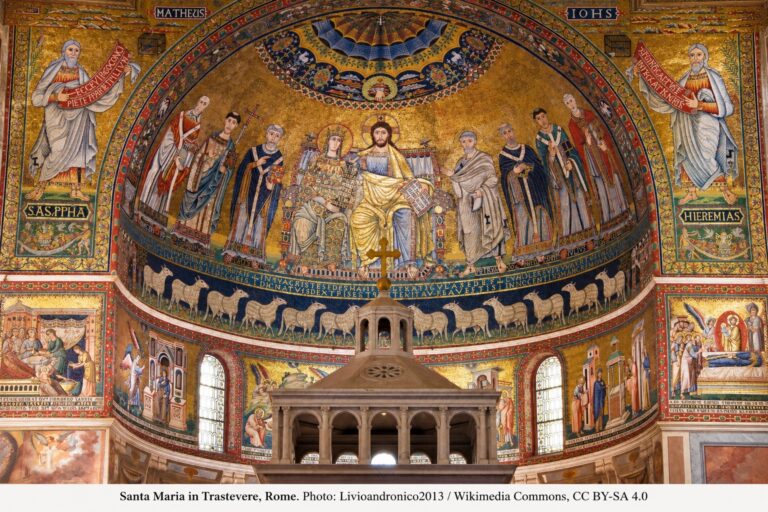
Padre Mirko arranged for us to stay with some Spanish sisters, just a few streets away from Santa Maria in Trastevere, one of Rome’s oldest basilicas. As soon as we dropped off our luggage, we went to see its mosaics.
Dorota sat down next to me:
— “Sweetie, I was given a penance, but I don’t know how to pray it.”
— “What did you get?”
— “The Chaplet of Divine Mercy.”
I took out my rosary:
— “I’ll start, and you join in. You’ll pick it up quickly.”
Christmas Eve and Midnight Mass with the Pope
The next day was Christmas Eve. We had dinner in a little square somewhere among the charming old buildings of Trastevere, sitting outside under gas heaters with a handful of other tourists. There were no uszka on the Christmas menu. No beet soup. I don’t think there was even any fish. There was definitely some kind of meat.
At around eleven that night, we were supposed to meet a Polish nun who had tickets for us to Midnight Mass with Benedict XVI. She led us through the side gate on the right, the one by the little church of Sant’Anna dei Palafrenieri. We passed the first guard, went up some stairs, crossed a large hall, and continued toward another papal guard. All the while, she was moving the beads of her rosary through her fingers. Then it turned out that one ticket was for Midnight Mass and the other was for the New Year’s Mass.
So we were only half legal.
Out of the corner of my eye, I saw Dorota wiping away tears. Over the next few days, I saw her cry again at the tomb of John Paul II during Mass in the crypt of St. Peter’s Basilica, and when we met Padre Mirko, who took us to St. Paul Outside the Walls.
Not in the Way I Had Imagined
A few years earlier, during a pilgrimage to Cologne, I had received a word from the Acts of the Apostles, chapter 9 — the passage where Peter raises Tabitha. Tabitha is also called Dorcas.
At the time, I hoped that Peter would heal her. And he did. Just not in the way I had imagined. Dorota died on the Feast of the Exaltation of the Holy Cross, a year and almost nine months later.
When I was with her in the hospital on that last day, I asked her:
— “Sweetie, what can I bring you? What do you need?”
She said:
— “O God, come to my assistance.”
There was a breviary lying on the metal cabinet beside her hospital bed. I began to pray the psalms. By then, she had been praying the breviary regularly for some time.
Many years have passed. And only today have I realized that back then I was touching Christmas in the way St. John writes about:
“That which was from the beginning, which we have heard, which we have seen with our eyes, which we have looked upon and touched with our hands, concerning the word of life—the life was made manifest, and we saw it, and testify to it, and proclaim to you the eternal life which was with the Father and was made manifest to us—”
(1 John 1:1–2, RSVCE)